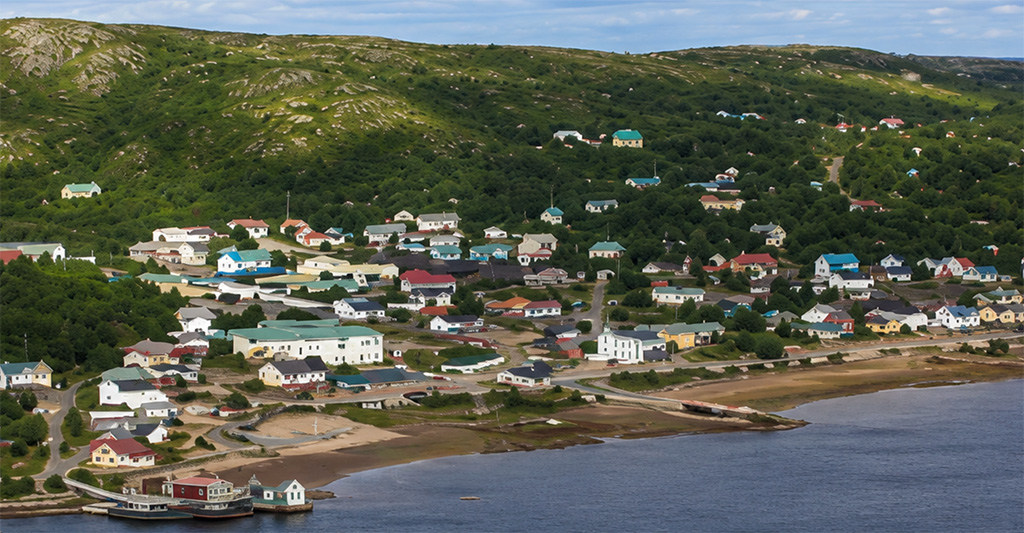
The Saint-Augustin area was originally inhabited by the Innu and Inuit, whose presence gradually declined with the arrival of Europeans.
land grant
inhabited land
today
By the end of the 17th century, a French trading post had been established on Île du Vieux-Poste, marking the beginning of a European presence. In 1702, a vast land grant was awarded to Augustin Le Gardeur de Courtemanche, who would later lend his name to the river, the bay, the harbour and finally the village. Around 1720, an active trading post attracted hunters, fishermen and trappers, forming the nucleus of the future village.
Following the British conquest of 1760, the trading post changed hands and came under the control of the Hudson's Bay Company, which rebuilt it in 1870. In the early 1820s, two brothers from Boston bought the post from a bankrupt company and established a thriving salmon and seal fishing industry there. Between 1820 and the end of the 19th century, the region opened up to newcomers from England, Quebec, Newfoundland and the United States (New England). Over time, residents left the surrounding islands to settle permanently at the present-day site of Saint-Augustin, initially in winter, then year-round, and Saint-Augustin became a hub of intense hunting, fishing and trade. The diversity of its inhabitants gave rise to a population comprising Innu, French-speakers, English-speakers and, above all, Métis people resulting from marriages between Indigenous peoples and Europeans.
The village gradually became one of the most important settlements on the Lower North Shore thanks to its rich fishing grounds (salmon, cod, trout, mackerel, and shellfish), its location on the banks of the Saint-Augustin River, and its historic role in trade and navigation.
Saint-Augustin officially attained municipal status on 1 January 1993, following the administrative restructuring of the Côte-Nord-du-Golfe-Saint-Laurent region. It covers more than 1137 km² of inhabited land, making it one of the largest villages on the Lower North Shore. The community is now home to nearly 800 residents, each with their own story to tell. Located directly opposite the village, on the other bank of the Saint-Augustin River, lies the Innu community of Pakuashipi.
Saint-Augustin is renowned for its Métis culture, its historical links with the major fur-trading companies, the preservation of a living heritage passed down by families who have lived there for several generations, and its remote location, as Saint-Augustin is accessible only by plane, by boat and via the White Road in winter.
The villagers remain deeply attached to their history, steeped in traditions, hospitality and a deep sense of belonging. The current population is largely Métis, blending Inuit, Innu and European heritages, and still practises traditional activities such as hunting, fishing and gathering.
Saint-Augustin, Basse-Côte-Nord · Coastal Legacies
Le territoire de Saint-Augustin était à l'origine fréquenté par les Innus et les Inuit, dont la présence a progressivement diminué avec l'arrivée des Européens.
Courtemanche
terres habitées
aujourd'hui
Dès la fin du 17e siècle, un poste de traite français est établi sur l'île du Vieux-Poste, marquant le début d'une présence européenne. C'est en 1702, qu'une vaste concession territoriale est attribuée à Augustin Le Gardeur de Courtemanche, qui donnera plus tard son nom à la rivière, à la baie, au havre et finalement au village. Autour de 1720, un poste de traite en activité attire chasseurs, pêcheurs et trappeurs, formant le noyau du futur village.
Après la Conquête anglaise de 1760, le poste change de mains et passe notamment à la Hudson's Bay Company, qui le reconstruit en 1870. Au début des années 1820, deux frères de Boston rachètent le poste d'une compagnie en faillite et y développent une industrie florissante de pêche au saumon et au loup marin. Entre 1820 et la fin du 19e siècle, la région s'ouvre à de nouveaux arrivants en provenance d'Angleterre, du Québec, de Terre-Neuve et des États-Unis (Nouvelle-Angleterre). Au fil du temps, les résidents quittent les îles environnantes pour s'établir de manière permanente sur le site actuel de Saint-Augustin, d'abord en hiver, puis toute l'année, Saint-Augustin devient alors un lieu d'activités intenses de chasse, pêche et commerce. La mixité de ses habitants donnera naissance à une population composée d'Innus, de francophones, d'anglophones et surtout de Métis issus de mariages entre Autochtones et Européens.
Le village devient graduellement un des centres habités les plus importants de la Basse-Côte-Nord grâce à ses riches zones de pêche (saumon, morue, truite, maquereau, crustacés), à sa situation en bordure de la rivière Saint-Augustin et à son rôle historique dans la traite et la navigation.
Saint-Augustin accède officiellement au statut de municipalité le 1er janvier 1993, à la suite de la restructuration administrative de la Côte-Nord-du-Golfe-Saint-Laurent. Elle s'étend sur plus de 1 137 km² de terres habitées, ce qui en fait l'un des plus vastes villages de la Basse-Côte-Nord. La communauté abrite aujourd'hui près de 800 habitants, chacun ayant sa propre histoire à raconter. Situé juste en face du village, sur l'autre rive de la rivière Saint-Augustin, se trouve la communauté innue de Pakuashipi.
Saint-Augustin est réputé pour sa culture métisse, ses liens historiques avec les grandes compagnies de traite, le maintien d'un patrimoine vivant, transmis par des familles installées depuis plusieurs générations, et son caractère isolé puisque Saint-Augustin n'est accessible que par avion, par bateau et par la Route Blanche l'hiver.
Les villageois demeurent attachés à leur histoire, entourée de traditions, d'hospitalité et d'un profond sentiment d'appartenance. La population actuelle est largement métisse, mêlant héritages inuit, innu et européens, et pratique toujours des activités traditionnelles comme la chasse, la pêche et la cueillette.
Saint-Augustin, Basse-Côte-Nord · Coastal Legacies