Listen · Narrated · 4:34 Écouter · Narration · 4:34
0:00 / 4:34
The legend of the Black Cometic, told in Tête-à-la-Baleine on Québec's Lower North Shore, is a local story passed down orally. It forms part of the intangible heritage of this remote region, where tales are often shared from generation to generation—around the fire or during evening gatherings.
It sometimes describes the appearance of a ghostly sled gliding alone across the ice, often just before a storm or a mysterious disappearance. Considered a bad omen, it is surrounded by a taboo: never follow its tracks, for they are said to lead to a world of no return.
The “bonne femme Charlie” of Tête-à-la-Baleine appears to be a local figure mentioned in oral stories from the Lower North Shore, but there are currently no official bibliographic or historical sources that clearly document her identity or role in the village's legends. She may be part of the regional folklore, passed on by word of mouth—like many mysterious or emblematic characters that inhabit the stories of this isolated community.
Tête-à-la-Baleine
Whenever the old fishermen told scary stories, there was always one who ended up saying: “They say that when they buried old Charlie's woman, there was nothing left in the grave.”
She was a big, heavy woman who sold booze and had lived her life without ever practicing religion. Even the men who went to see her for a drink were afraid of her. She spoke loudly, and when the men “got out of line,” she “put them back in their place.”
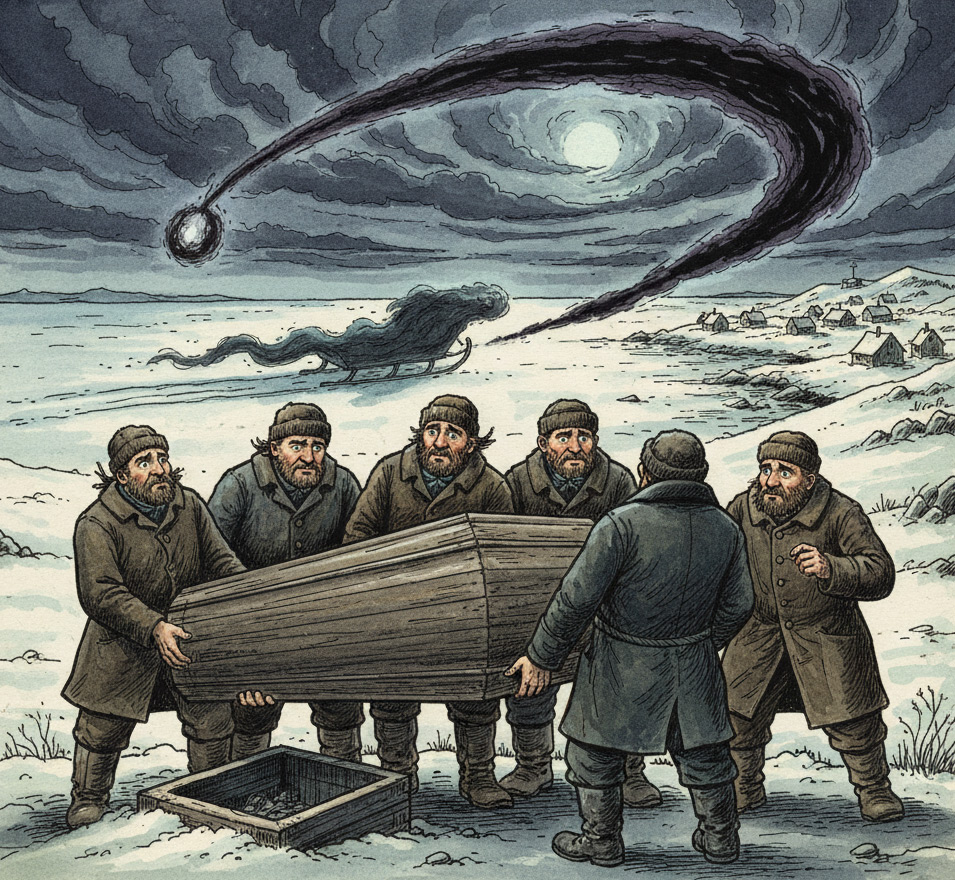
One fine day, the coastal folks heard that the old woman had died. Ha! That didn't sit well with those who used to visit her. They chose six “strong men,” capable fellows, because they had to carry the coffin two miles away, where there was enough earth over the rock to bury her.
When they got there, they gave themselves a push to lift the coffin—but surprise! The grave was empty! Not one of the pallbearers dared say a word; each one thought the others were carrying all the weight. They went ahead with the burial as if nothing had happened, but on the way back, the pallbearers realized they had all understood that the woman was no longer in the coffin.
But the story doesn't end there. That very evening, two hunters walking on the ice along the bay saw a large black cometic sled coming toward them, driven by a man dressed entirely in black who wasn't from around there. Then they saw, tied to the cometic, a red sleigh in which a large person was lying down.
It was heavy, because the black dogs pulling the sled had their tongues hanging out and sweat glistening on their bodies. The two hunters didn't say a word—they were scared and hid behind some rocks. When the sled disappeared behind a patch of little Saint-Michel trees, the bolder of the two hunters wanted to step forward to see which way the sled was heading, but the driver turned his face toward him—and they say it was the devil.
The two hunters picked up their pace and tried to enter the first house they saw to spend the night. Since they were returning from a month in the forest and didn't know what had happened to Charlie's woman, they couldn't understand why there was no light in her house that night, because it was her door they were knocking on.
Since she didn't answer, they cracked the door open to peek inside. There was nothing left; the stove was cold, and a cloud of soot escaped through the door they held ajar.
Tête-à-la-Baleine, Basse-Côte-Nord · Coastal Legacies
La légende du Cométique noir, racontée à Tête-à-la-Baleine sur la Basse-Côte-Nord du Québec, est un récit local transmis oralement. Elle fait partie du patrimoine immatériel de cette région isolée, où les histoires se transmettent souvent de génération en génération — autour du feu ou lors des veillées.
Elle décrit parfois l'apparition d'un traîneau fantôme glissant seul sur la glace, souvent juste avant une tempête ou une disparition mystérieuse. Considérée comme un mauvais présage, elle est entourée d'un tabou : ne jamais suivre ses traces, car elles mèneraient, dit-on, vers un monde sans retour.
La « bonne femme Charlie » de Tête-à-la-Baleine semble être une figure locale mentionnée dans les récits oraux de la Basse-Côte-Nord, mais il n'existe actuellement aucune source bibliographique ou historique officielle qui documente clairement son identité ou son rôle dans les légendes du village. Elle appartiendrait au folklore régional, transmis de bouche à oreille — comme bien des personnages mystérieux ou emblématiques qui habitent les histoires de cette communauté isolée.
Tête-à-la-Baleine
Chaque fois que les vieux pêcheurs racontaient des histoires de peur, il y en avait toujours un qui finissait par dire : « On dit que lorsqu'ils ont enterré la femme du vieux Charlie, il n'y avait plus rien dans la fosse. »
C'était une grosse femme, lourde, qui vendait de la boisson et qui avait vécu sa vie sans jamais pratiquer la religion. Même les hommes qui allaient la voir pour prendre un verre avaient peur d'elle. Elle parlait fort, et quand les hommes « dépassaient les bornes », elle les « remettait à leur place ».
Un beau jour, les gens de la côte ont appris que la vieille était morte. Ha ! Ça n'a pas fait l'affaire de ceux qui avaient l'habitude d'aller la voir. On a choisi six « hommes forts », des gaillards capables, parce qu'il fallait porter le cercueil à deux milles de là, où il y avait assez de terre par-dessus le roc pour l'enterrer.
Arrivés là-bas, ils se sont donné un élan pour soulever le cercueil — mais surprise ! La fosse était vide ! Pas un des porteurs n'a osé dire un mot ; chacun pensait que les autres portaient tout le poids. Ils ont procédé à l'enterrement comme si de rien n'était, mais au retour, les porteurs se sont rendu compte qu'ils avaient tous compris que la femme n'était plus dans le cercueil.
Mais l'histoire ne s'arrête pas là. Le soir même, deux chasseurs qui marchaient sur la glace le long de la baie ont vu venir vers eux un grand cométique noir, conduit par un homme habillé tout en noir qui n'était pas de la place. Puis ils ont vu, attaché au cométique, un traîneau rouge dans lequel une grosse personne était couchée.
C'était lourd, car les chiens noirs qui tiraient le traîneau avaient la langue sortie et la sueur luisait sur leur corps. Les deux chasseurs n'ont pas dit un mot — ils avaient peur et se sont cachés derrière des rochers. Quand le traîneau a disparu derrière un bouquet de petits arbres de la Saint-Michel, le plus hardi des deux chasseurs a voulu s'avancer pour voir de quel côté il se dirigeait, mais le conducteur a tourné le visage vers lui — et on dit que c'était le diable.
Les deux chasseurs ont pressé le pas et ont voulu entrer dans la première maison qu'ils ont vue pour y passer la nuit. Comme ils revenaient d'un mois dans le bois et ne savaient pas ce qui était arrivé à la femme de Charlie, ils ne comprenaient pas pourquoi il n'y avait pas de lumière chez elle ce soir-là, car c'était à sa porte qu'ils frappaient.
Comme elle ne répondait pas, ils ont entrouvert la porte pour jeter un coup d'œil à l'intérieur. Il ne restait plus rien ; le poêle était froid, et un nuage de suie s'est échappé par la porte qu'ils tenaient entrebâillée.
Tête-à-la-Baleine, Basse-Côte-Nord · Coastal Legacies